How a Formula Student Team Built Wireless Telemetry with FlexiHub
Getting live data out of an electric race car without cables is harder than it sounds. Here's how one student team solved it.
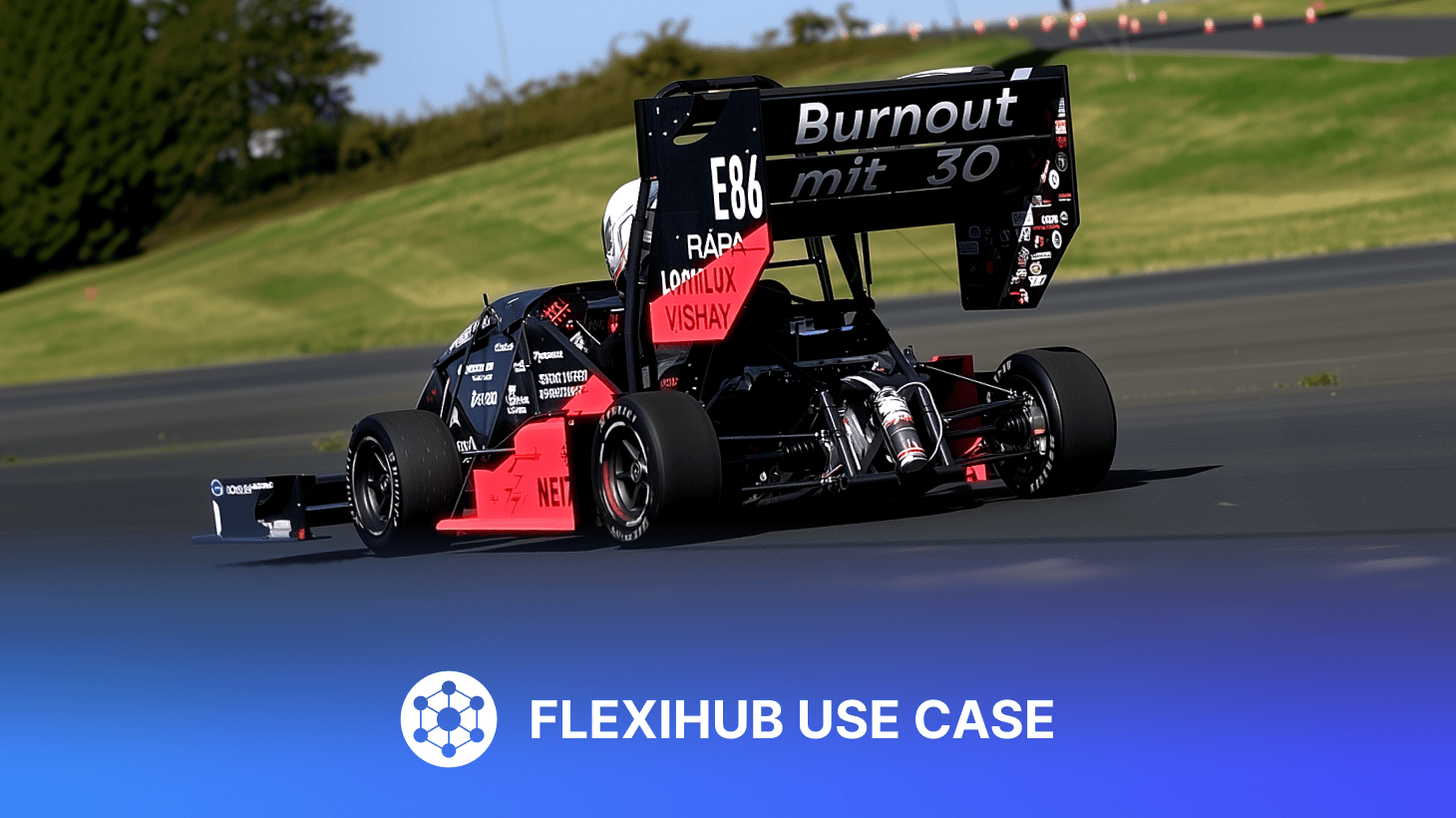
The Problem
Formula Student teams live by data. Every adjustment to a fully electric race car — motor tuning, battery management, suspension setup — depends on knowing what the car is actually doing. That means reading the CAN bus: the internal network that carries every sensor signal in the vehicle.
The standard approach requires a USB interface plugged directly into a laptop running analysis software. It works, but it creates a hard constraint: the engineer has to be physically next to the car. During live testing with a running motor, that's not always safe. During software updates, it slows everything down. On a busy racetrack, it's simply impractical.
This team needed the data to come to them.
Who's Behind It
Subteam Elektro is the electrical engineering division of HofSpannung Motorsport, the Formula Student team of the University of Applied Sciences Hof. They own everything that carries current in the car — the high-voltage battery system, motor controllers, wiring, sensors, and the data infrastructure that ties it all together. Getting live CAN bus data out of a running car and into the hands of engineers is their problem to solve.
The Setup
The solution they put together is technically clean. A Raspberry Pi is mounted inside the car's chassis with a Vector VN1610 CAN bus interface plugged directly into it. A WiFi router positioned near the car provides the network link. FlexiHub runs on both the Pi and the engineers' laptops, presenting the USB interface as if it were locally connected — wherever the laptop happens to be.
Before committing to the full setup, the team validated the concept using FlexiHub's free trial and two laptops. The Vector software on the remote machine detected the CAN interface without issue. Data came through cleanly. That was confirmation enough to move forward with the Raspberry Pi installation in the car.
This video describes the whole use case:
What It Unlocked
With the wireless pipeline in place, the team gained four concrete improvements to their workflow:
Live CAN bus data is now readable from the pit wall with no physical connection to the car. Software updates to the car's CPUs can be pushed remotely in seconds, whether the engineer is standing beside it or connected from elsewhere. Real-time simulations can run with the motor active, without requiring anyone to be in close proximity to it. Log readouts can be pulled at any point without stopping a session or opening the car.
The team's own summary is straightforward: FlexiHub improved their workflow, allowed them to run better and safer tests, and helped them build a more reliable car.
Where It Gets Complicated
The workshop environment was stable, and the connection performed well. The racetrack was a different story.
At competition, the car's onboard WiFi router struggled with reception in the congested RF environment of a paddock. The connection became unreliable at the distances involved. Separately, the data device's drivers had difficulty with the network overhead — USB-over-IP introduces latency, and some drivers handle that less gracefully than others.
The team's assessment was clear-eyed: FlexiHub itself worked as expected and was straightforward to set up. The bottleneck was network quality, which is an infrastructure challenge rather than a software one.
What Subteam Elektro built is a practical wireless telemetry solution assembled from a single-board computer, a router, and FlexiHub. It's not a bespoke system — it's a replicable setup that gives small teams real capability without high cost or integration overhead.
The data gets to the engineers. The engineers stay safe. The development loop gets faster. For a student team building a competitive electric race car on a constrained budget, that's a real result.